MUSICIANS' RESOURCES
Home | Introduction | Free Concert Calendar | Radio Stations in Los Angeles and the Internet | Bands | Record Labels | Audiophile Hi-Fi Stereos | Home Audio Hi-Fi Stores | Car Stereos | Car Stereos Stores | Commentary on Hi-Fi | Please Help Promote My Audio Webpage | Record Stores | Musicians Info | Materialism | Entertainment Industry Resources | Restaurants | Public Libraries | Miscellaneous | Andrew's Bookmarks | Register for special events | Send me Email
Please bookmark and link to this webpage which will point to wherever this website is currently located. One free webhost after another has either shut down, limited bandwidth, or cluttered my webpages with advertisements. If you found this page from a search engine, chances are you'll never find it again so Bookmark that webpage now!! If you found this webpage from a search engine, search for multiple instances of your search query.

Panic!! On Wed, 22 Jan 2003 the owners of freewebs.com sent me an email telling me that they will now limit bandwidth transfer for this free account and will now start charging money for higher bandwidth transfer. That means they're going to start blocking my website when "too many" people want to visit it. Once again, I'm being shut down. Please help me find another free webhost that has unlimited bandwidth transfer ASAP. Thank you.

If anyone knows of any inaccuracies on this webpage, Email ME here (remove the NOSPAM. part from address and change subject to 'Inaccuracy report Musicians') and I will correct them immediately upon verification.

NOTE: The comments on this webpage are my opinions which some people disagree with. Some people have invested a lot of money in their instruments and would like to see their instruments increase in value as have collectable "vintage" guitars. When I post information that does not complement their perceived valuations of their investments, some people become upset. For those of you who are willing to think and listen for yourselves, disregarding the false materialistic values of valuing instruments as status symbols, enjoy. For whatever reasons you spend your money on instruments; as ego-trophies, as collectable investments, or as actual instruments you will play, enjoy.

WARNING: Boutique guitars and amps are unreasonably overpriced. An item is worth only what you can get for it when you sell it; that's the item's real world resale value, not the item's MSRP or retail price is. Guitar dealers have been scamming customers for years by charging extra for the case or gigbag which most manufacturers include with each new instrument; any discount you negotiate is lost when you buy the case. Used "vintage" guitars and amps are unreasonably overpriced. The majority of vintage and boutique guitars and amps are owned by speculating collectors who hoard them for bragging rights or for profit, not "connoiseur" players. Buy only used equipment 1-2 years old. Boycott new overpriced anythings. That is the only way to send a message to manufacturers to price new equipment at reasonable levels. Most "brands" are just marketing companies ("virtual" corporations) that OEM and outsource everything from subcontractors- parts, factory assembly, and marketing. All the assembly factories I've seen had minimum wage illegal alien workers. Most parts are made by robots in automated factories. CNC means "computerized numeric control" and many machines are made by Thermwood. Technology is supposed to be making better products at lower costs, but the corporations are too greedy and charge boutique prices for factory automated outsourced products; they never pass their savings on labor onto the consumer. No wonder why sales on overpriced guitars are down. There is no justification for production line guitars to be so overpriced.

Marketing terms: Perceived value; potential customers make purchase decisions considering a product's perceived price. That is, how much a customer thinks that a product will cost them. These perceptions may or may not accurately reflect reality. Creaming means selling product range at a higher than average price in order to improve perceived value, known as "upmarketing" a product, whereby it becomes the accepted purchase of the more affluent members of society. Creaming or skimming is selling a product at a high price, sacrificing high sales in order to earn high profits. Upmarket products tend to ride the storms of economic depression better than cut-price products. Upward Stretching means introducing a new product into a product line at the higher priced end of the market. Confusion Marketing is a controversial strategy of deliberately confusing the customer. Examples are alleged to be found in the telecommunications market, where pricing plans can be so complicated that it becomes impossible to make direct comparisons between competing offers; Fender does this with their redundant models that have minor cosmetic differences so that their many dealers which are in close proximity to each other don't have to compete on price.

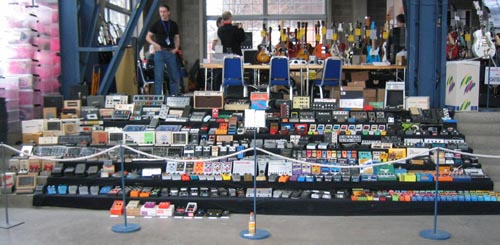
Guitar Shows are just becomming real wastes of time. The scheduled bands never show up, the scheduled celebrity musicians never show up, the parking fees for these swap meets are rip offs, and they try to sell t-shirts to commemorate their swap meets at $20 ?? Who wants to commemorate a swap meet? The dealers could at least put new strings on the guitars. They're just bunch of "trunk gypsies" and fat old men who are hussling beat up used guitars and amps at outrageous prices. Even though the guitars are sold as "mint", the more expensive guitars have swapped out pickups because it is more profitable to sell vintage guitars and pickups seperately, and many are outright fakes/forgeries/frauds. It's amazing how many 1965 Fender Strats there are at guitar shows; never any 1957-1964, never any 1966-2002, nope, just 1965 Strats in various states of wear as if Fender only made guitars that one year, it's so amazing it's unbelievable. Also at guitar shows there are parts dealers selling replacement decals that are exact replicas of the original vintage decals. Those really beat up guitars have broken neck trussrods and are made up of parts from different years and different manufacturers. By the time you see it, all the good parts have been taken. Buy only used equipment 1-2 years old from a brick 'n mortar dealer. Any instrument older than a couple of years is likely to have been modified. I've seen hundreds of Fenders and Gibsons advertised as "mint/vintage" and many had swapped in counterfeit pickups.

Mars Music Bankrupt. Mars Music closed all their stores in Southern California last year. I directly blame the big name brand manufacturers for overpricing their products to outrageously unreasonable price points, pricing themselves out of the market. Fender tried to sell guitars made by robots in automated factories for $900+; Gibson tried to sell production line guitars for $2000+, Taylor tried to sell acoustics for $1500+, the stuff that was affordable was shoddy imported junk, so of course nobody bought them and the stores suffered. I'm sick of unbridled greedy manufacturers destroying their own markets. The manufacturers live in a DOT-COM fantasy world thinking that if they slapped a DOT-COM to their names and used a "vintage" marketing ploy to sell their overpriced guitars, they'd be billionaires overnight. The manufacturers treat their customers like ATM cash machines they could keep asking for more and more money each year. Mars Music stores in Southern California were great and their Lawndale store hosted an open blues jam every Tuesday night. Unfortunately they couldn't sell guitars at the overpriced prices the manufacturers were demanding. My sincere sympathies to the people at Mars Music.

Exhibitions Fender Museums: The Fullerton Museum in Fullerton, CA is having a special exhibition "A Shower of Brilliance: Leo Fender and his Electric Guitars" that Fender afficianados would enjoy (date on website is wrong, call first to verify). There are guitars there for you to play too, Fullerton Museum Fender Exhibit. The Fender Museum in Corona, CA is now open. The Fullerton Museum exhibit is the better one, but both exhibits are disapointments. You can see a much better free exhibit of vintage guitars at Guitar Center Hollywood's Vintage Guitar Room.

1951 Fender Nocaster demonstrates how "vintage" guitars can be faked. When the older collectors pass away, the next generations of musicians will probably not venerate used guitars. Old used beat up guitars will have antique value, not instrument value. Guitars today are made at a much higher quality than guitars made 50 years ago.

Guitars
Commentary and Links

Rock stars don't actually own the guitars and amps you see them use on tour, in their videos, and in photos. Rock stars want to save their money for their drugs, trophy girlfriends, fur coats, and absurdly stupid luxury items. Rock stars rent their equipment at places such as Styles Music, Alta Loma Music, Andy Brauer Studio Rentals, L.A.FX Studio Rentals, Lon Cohen Rentals, Third Encore, and Studio Instrument Rentals Hollywood. Rock stars may keep a few trophy guitars in their homes and use those for home recording. Rock stars keep their trophy gear at home when they leave to record and perform. You can rent the exact same equipment your favorite rock stars used to record and tour with. At those equipment rentals places you can find equipment with long histories of usage by many famous rock bands and you'll find out the same equipment was used by many different musicians playing vastly different genres. So if you're going on tour and want a 60's guitar and amp, rent them, and you won't panic when they get dropped and banged around or even stolen because your prize trophy gear is safe at your house. Don't forget, rock stars don't actually own those amps in their videos and hardly any of the guitars - they're all rented.

The truth is that the "tone" of your guitar and amp is in your fingers and your music. Unless you are playing solo guitar without any effects and the guitar is a solo lead instrument (not just rhythm), guitars tend to sound the same. Many guitar fans want to emulate their rock star idols by buying the same equipment their idols endorced. But unless you read interviews of people who were actually there when those rock stars made their famous recordings, you won't know what equipment was actually used. For example: fans of Jimi Hendrix buy Fender Stratocasters and Marshall amps, but Hendrix actually made his most famous recordings with Gibson and Hofner and Epiphone and Gretsch guitars into Silvertone and Burns and Fender amps, for live performancs Hendrix used solid state "fuzz" pedals into "clean" Marshall amps; fans of Jimmy Page buy Gibson Les Paul guitars and Marshall amps, but he made his most famous recordings with Fender Telecaster and Danelectro guitars into small "practice" Fender Champ amps; B.B. King made some of his most famous recordings with Fender Telecasters; Mark Knopfler recorded with guitars by Pensa; Stevie Ray Vaughn's "main" recording guitar was a Hamiltone built by James Hamilton with EMG pickups, and he also used Gibson guitars with a Silvertone amp and a Fender Vibroverb amp with an Ibanez TS-9 pedal, the amps he recorded with are considerably less expensive than the Dumble amp and beat up guitars he toured with and used in videos and photos; the guitarist for U2 uses a wide variety of guitars such as Gibson, Rickenbaker, Fender, etc., but no matter what he uses he still sounds like him and nobody can differentiate which guitar was used on his recordings, not even him; Slash, was the famous "Gibson" guitarist for Guns 'N Roses, but his guitar was actually a replica guitar built by an independent luthier who didn't even work for Gibson; Kurt Cobain appeared on stage with a Marshall amp that wasn't even plugged in, the cabinets were empty so he could more easily shove his guitar neck through the cloth when he "trashed" his equipment at the end of his concerts, he actually used an Ibanez TS-9 and SansAmp into the PA; some rock stars have used such a wide variety of guitars and amps that even they can't remember what they've used. Some people pretend to be connoisseurs of amp "tone" and speak revently of "tube tone", without realizing that their idols used solid state effects pedals like the Ibanez TS-9 and their amps "clean." It's amusing to see people spend lots of money collecting equipment to emulate their idols, but all the while they've had no idea what equipment their idols actually used. Some people want to emulate their idols like tribute bands do and they try to adopt their identities from their posessions; they say things like "I'm not a Fender-man, I'm more of a Gibson-man", all the while they're completely mistaken about what their idols actually used.

When playing live, after the guitar goes through the amp and the amp goes through the microphones, then the PA, and the PA blasts the room at unreasonably loud volumes, you really can't hear the difference between one brand's guitar, pickup combination, amp, from another. When recording, after the guitar goes through the amp and the amp goes through the microphones, through the mixing board, through dozens of effects boxes, through compression, you really can't hear the difference between one guitar, brand, pickup combination, amp, from another. Many of the guitars on hit records today were recorded on Pro-Tools and run through dozens of effects using either the "Line6 Amp Farm" or "AmpliTube" simulators. Even when the guitar and amp are recorded dry, they are usually "doubled" with multiple tracks to "thicken" the sound. The least expensive high quality USA guitars and amps are by Carvin. The lowest you can spend on quality imported guitars and amps is Yamaha. The best prices are always for 1-2 year old used gear, dealer demos, clearance items, and dealer blowouts.

GUITARS
Boutique Guitars, Independent Luthiers, High End Guitars
In the early 50's all guitars made by Fender, Gibson, Epiphone, etc., were built to very high standards with high-grade components, alnico magnets, strong tuners, glossy nitro cellulose laquer finishes, and made to last. Back then, making guitars individually by hand was the only way to make them. What was considered to be "consumer/professional grade" back then would be considered to be "expensive boutique" today. Today most guitars are OEM'd from factories in Korea, China, Taiwan, Mexico, Indonesia, India, and wherever else the labor and cost of materials is cheapest. Mass produced guitars sometimes look nice with woodgrain tops, but they are made from thin veneers laminated on top of cheap plywood, particle board, and composite woods. Most "expensive boutique" guitars are made from solid aged tone-woods. Today's "consumer grade" guitars can sound ok, but if you want the sound and tone of the guitars made in the 50's and 60's, you'll have to spend more money on "expensive boutique" guitars. Plus when you buy an "expensive boutique" guitar, you can sometimes meet the actual person that hand-made your guitar and get the satisfaction that you're buying something made in the USA by someone who really cares about music and his craft instead of some re-badged product which comes from a 3rd world country where an impoverished pre-teen working for no-pay in unsafe conditions for very long hours uses the absolute cheapest materials and alternates the headstock brand-badges depending on the time of day. Examples would be Fender's alternate badging of their guitars as being "Squier", "Fender", or "Yorkville/Traynor", and the world's largest guitar maker Samick badging their guitars as for "Epiphone/Gibson", "Washburn", "Hamer", "Slammer", "Kima", "Danelectro", "Archer", "Ibanez", "Rogue", "Hohner", "Slammer", "Memphis", "Montana", "Grand", "Dean", "Johnson", "Commodore", "Hondo", "Cruise", "Kramer", "Karera", "Sterling", "Lyon", "Mitchell", "Music Drive", "Santa Rosa", "Jay Turser", "DeArmond", "Abilene", "Shredder", "Sigma", "Sebring", "Eagle", "Rokker", "Joshua", "Mr. Potato", "Ltd", "MD", and dozens of other marketed brands. Sam Ash Music stores has their own "Carlo Robelli" brand and Guitar Center has their "Mitchell" brand of imported Korean made guitars. The OEM'd brands have minor cosmetic differences, but those rebadged guitars are made from the same parts and sound the same, lacking in tone and character. Another thing to consider is that OEM'd and imported guitars get drastically devalued as soon as they are sold while hand-made boutique guitars increase in value over time. A common sentiment among guitar dealers is that "what you're paying for are the pickups, the import guitars loose about 1/3 their value as soon as you [buy them and] walk out the [store] doors with them." The aftermarket pickups and parts market was created so that musicians can modify imported guitars with USA made parts. I predict Asian made guitars to eventually increase in quality to match and surpass USA made guitars now that they are using increasingly sophisticted CNC manufacturing and are seriously competing on price whereas the USA makers are increasing their prices and marketing their products on "percieved value." The "kids" today are into music where their rock idols use $200 Asian made guitars, expensive guitars (to them) are for "old people." The USA makers' insatiable greed is alienating their next generations of buyers.
Something else to consider in deciding "what it is you are paying for" are the demo guitars used by Don Lace Pickups and Roland Instruments at guitar stores and guitar shows - they use the absolute cheapest imported guitars and replace only the pickups to demonstrate their products. Notwithstanding any kind of hardware, body woods, fretwork, finish, maybe those guitars prove that the pickups are the only relevant parts.
The bad aspect of "expensive boutique" guitars is that they are usually absurdly expensively overpriced. Some of the reasons for that are: the builders are guys working out of their garages handmaking each one by one - taking a month to make each one - they need to make a living; they're electrical engineers and not businessmen and naive about how much they can charge and run a business (they know nothing of marketing and distribution); they use expensive parts and can't get discounts on prices because they sell so few of them; they see that other "expensive boutique" companies charge high prices and figure they can sell their products for around the same prices because they've received good magazine reviews; and some are just plain greedy. Be aware that many boutique builders outsource many components; the name on the headstock is the designer: the body is cut and finished by somebody else, the pickups are by somebody else, the hardware is by somebody else, and it's assembled by assistants. Paul Reed Smith and Bob Taylor haven't actually built a guitar in decades. PRS' overpriced guitars are the prime examples of guitars made for "hip lawyer wall decorations" (with emphasis on glossy finish and exclusive high price) instead of being instruments for working man musicians. You can understand why a handmade guitar might be expensive, but when a company is selling imported guitars made entirely by automated machines and charging insanely high prices, they're selling you "image" and "brand name" not guitars. The "price" is the "product."
You buy the guitar to make music, you choose a particular guitar for it's sound and playability, but the finishes and inlays are the most expensive costs in guitar building. Guitar builder Ed Roman said "I think another even bigger reason that the bolt in neck models are perceived to be not as good as the set neck models is because there are many more cost adding options on most of the set neck models. Many uninformed people think that the more something costs the better it has to be. True in some cases but In this case that is absolutely not true. ... With the consumerist false notion that high price equals high quality that companies like Gibson have been shoving down consumers throats for years. It's no wonder people perceive the set neck models are better. Nothing could be farther from the truth. ... Don't pay handmade prices for production guitars"
Find out which guitar company uses which pickups. If a company OEM's their pickups, then you might as well buy an imported guitar like a Samick, Fender Mexican, or Yamaha and replace the pickups with the same ones the boutique brand uses and save yourself lots of money. They get away with selling OEM'ed pickups and parts by saying they designed the parts which were made under their close supervision, but they just outsourced a subcontractor and stamped their logos on OEM'ed pickups. Many guitar companies like Fender, Steinberger, PRS, etc., actually OEM pickups from Seymour Duncan and EMG Pickups. G&L Guitars, now owned by BBE, actually OEM's some pickups from Japan and Korea while advertising their products as being "handmade in the USA."
Many "expensive boutique" guitars are overpriced more than the "vintage" guitars they're supposed to be copying. "Show" guitars are made for the annual NAMM conventions where manufacturers show off their products to dealers and guitar magazines. These guitars usually have exotic flamed or spalted woods, glossy finishes, and outrageous pricetags. "Show" guitars are for collectors who buy them as investments; these guitars will never be played or heard on any stage or recording. You have to decide if you're buying them as instruments or collector investments or ego trophies. Gimmicks such as "limited models", "short runs" or "special collectors series" usually have dubious justifications for huge price increases over "regular" models. Only Carvin sells new "boutique" guitars for reasonable prices, much less than the competition, much less than used "vintage" originals, and often win "best of" competitions in guitar magazines against guitars that cost thousands more.
Vintage guitars have gained an almost mythical reputation from various magazine writers throughout the years. I agree that the original "vintage" guitars were made with great workmanship and are of high quality. But I cannot say whether "vintage" guitars are better than new ones. Many "vintage" guitars are heavy, have thick necks, imprecise intonation, have worn out tuners that go out of tune after heavy playing (guitar hardware actually improved over the decades, older isn't better), and have low output pickups. The reason why the first guitar amps were overdesigned with too much gain was to compensate for the pickups' low output. Modern tremolos by Kahler, Schaller, and Floyd Rose, as big and ugly as they are, are far superior in keeping the guitar in tune, in precise intonation, and in ability to stay in tune after vigorous playing than vintage tremolos and tailpeices. Modern locking tuners by Schaller are far superior than vintage keys. The equipment used to make guitars today are much more precise, the luthiers are much more experienced (sometimes the same people who made the original vintage guitars are still making them today), and the guitars are much more consistent. If you find a "vintage" guitar that's over 30 years old that's still in good condition, maybe it's not a very good playing or sounding guitar. Great guitars get played and played guitars get worn, dinged, scratched, dented, and refretted because they're so good they've been played alot throughout the years. Also consider that over time, guitar pickups lose their magnetism and start to "fade." A 30 year old guitar will not sound the same as that guitar did 30 years ago. If you see a "vintage" guitar that's in too good of a condition to be in for it's age, consider that maybe it isn't a good one or that it's a fraud. Read this commentary on fake vintage guitars. If you liked Django's Maccaferri Guitars and Selmer Guitars, Maurice Dupont, Dell'Arte Instruments, David J. Hodson, and Michael Dunn make reissues that sound and play better than the originals. Beware that because dealers can make more money selling "vintage" guitars and pickups seperately, they often do and install new pickups in the "vintage" guitar and sell the original ones seperately.
Fender, Gibson Custom Shop, and Bernie Hefner's Edenhaus Guitars are available in "distressed relic" finishes. Their "relic" guitars look like used worn guitars and are great sounding and "liberating" to play. They copied the techniques of the counterfiet "vintage" guitar makers. Because boutique guitars are so expensive, many owners feel uncomfortable handling them because they fear any accidental bumps and scratches will ruin their value. Many people feel intimidated to handle some of the more outrageously overpriced boutique guitars. Since "relic" guitars are already beat-up looking, their owners feel more comfortable playing and handling them. I've long suspected that some "relic" guitars might actually be custom shop guitars that are "shopworn merchandise", "distressed merchandise", and "seconds merchandise" which have been un-"refurbished" - beat up more to disguise the flaws. I noticed that some of the "relic" Fenders had the old style Fender Custom Shop logos on them, meaning, that those guitars were actually "shopworn merchandise" that hasn't been sold. Fender's "closet classic relic" guitars just look like "seconds merchandise" which are guitars with bad finishes. Gibson's Tom Murphy demonstrates how he makes Gibson guitars to be "aged to perfection." The Complete Telecaster demonstrates how to "age" a guitar using show polish and other methods, making a fake vintage guitar is easy. Harry Pellegrin's creation of the Rory Gallagher Signature Model demonstrates how to make a severly reliced guitar from aftermarket parts. Fender Custom Shop Manager Mike Eldred demonstrates some techniques for relicing a guitar body. RS Guitarworks is a dealer that makes fake vintage guitars. Notable relic guitar builders include Bill Nash, Bernie Hefner, Mark Jenny, and the orginal "relic" maker, Vince Cunetto, a ghostbuilder for Fender in the 1990's, is now making relic guitars under his own brand. Robert H. Sickler 's The Building of Historic Replica Guitars and Amplifiers demonstrates how "vintage" guitars can be faked.

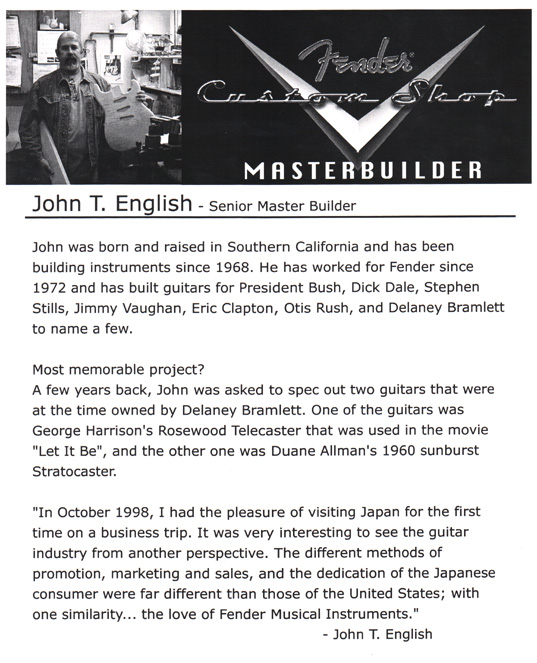
Custom shops are actually outsourced. The truth about "custom shops" is that they are actually independent luthiers who build the guitars outside of the factory. Those independent luthiers sometimes outsource to other independent luthiers who specialize in parts, finishes, and inlays. Most manufacturers don't have special sections in the factories where the "custom shop" builders go. Those special NAMM show and guitar magazine review guitars are made far away from the production lines out of luthiers' shops. Gibson's "custom shops" were "located" in the shops of luthiers who actually built guitars out of their garages. Ibanez's "custom shop" is actually Performance Guitar shop in Hollywood, CA. John Suhr used to work as a Fender "custom shop" builder out of his house far from the the factory. Roger Giffin used to work as a Gibson "custom shop" builder out of his house thousands of miles away from the the factory. Vince Cunetto was a Fender "custom shop" builder who made the first relic guitars. Gene Baker was a "custom shop" builder for both Fender and Gibson, when he started his own companies Baker Guitars/Fine Tuned Instruments; former Fender endorcee Robben Ford now endorces Baker guitars instead of Fender. John English makes "Fender Custom Shop" guitars and his own branded guitars out of his garage miles away from the official Fender factory. Alan Hamel and Fred Stuart make "Fender Custom Shop" guitars and their own "Alan Hamel & Fred Stuart" branded guitars out of their garages miles away from the official Fender factory. See the link below for CNC Magazine's article on the Fender Custom Shop. Larry Robinson does "custom shop" inlays for Martin Guitars and others. One of the reasons why "custom shops" have such long waiting periods is because the guitars have to be shipped back and forth between independent luthiers for each stage of assembly. Fender seems to have two "custom shops": one is a CNC line at their Corona factory for their "time machines" custom shop guitars and custom guitars assembled to customer specs from parts of the production line, and their other "custom shop" is an outsoured network of indepedent luthiers for their "masterbuilt custom shop" guitars. In this article CNC Magazine - Fender Custom Shop, John Grunder, the Fender Custom Shop’s head of sales says "Basically ... we make two types of guitars – player guitars and art guitars. There are a lot of people who buy guitars because they want to put them on the wall. They want something really unique, and they're not necessarily going to take it out and play it in a club. And then we do a lot of guitars for players who just want a really unique or personalized guitar that they can take out and play." So you see, those overpriced "art" guitars are just wall decorations. Fender outsources their "masterbuilt" guitars to independent luthiers and also runs a seperate in-house CNC factory line for "custom shop" guitars that differ slightly from their production line models; their price differentials for basically production line guitars with minor cosmetic changes are outrageous. Eventually "custom shop" builders start selling guitars under their own names when their names become more well known. Read Ed Roman's rant on Ghostbuilders for he is a ghostbuilder for Gibson.
At one time there used to be a real difference in sound between a guitar with single coil pickups, humbucking picksups, and blade pickups. Back then guitar amps were actually PA amps, nobody turned the gain up too high because they wanted to avoid distortion and feedback, and guitars were in the rhythm section. But the technology for each type of pickup has improved so that most new pickups today, even the "vintage reissue" models, are quieter than earlier ones and today if you really wanted to get rid of the noise, you can use a Roland noise gate pedal.
Gareth Weeks' commentary said in his commentary "Technology and the Electric Guitar" "... Rob Turner from pickup manufacturer EMG states that the idea of the Parker Fly is definitely a good one, but the only way people will buy such instruments is if Jimi Hendrix comes back to life and plays one! This implies that regardless of quality, consumers are only really interested in emulating their heroes even though that may involve using inferior products. Les Paul has stated also that the guitar industry is "stuck in the past" which highlights the fact that mainly due to consumer pressure, new ideas are seldom accepted with people preferring to use guitars which are associated with a musical figurehead. This also serves to indicate that although modern guitars, utilising new techniques and materials may be better quality and more versatile, guitarists want to emulate their heroes and use exactly the same 'brushes, paint and canvas'. ... the consumer has generally remained conservative in its approach. To conclude, it is apparent that there have been many attempts to combine technology with the electric guitar, many resulting in superior products than their earlier counterparts. However, despite this, the consumer is more interested in more old fashioned products utilising traditional materials and features."
As interesting as guitars look, there are still design flaws in the most popular models that have never been fixed. On most guitars there is still inadequate access to higher frets. Ibanez guitars have great access to the higher frets, but most of the famous guitar designs don't have easy access. I guess the cutaway shape is just cosmetic or for people with very long fingers. Also, the jacks on all electric guitars ought to be guitar strap jacks or endjacks or endpin Jacks. Tacoma Guitars, Martin Guitars, and a few others already do this. When the jack is on the front of the guitar, your wire sticks out of the guitar top and is easily accidently knocked out. When the jack is on the bottom of the guitar, the guitar is uncomfortable to play sitting down with the cable sticking into your leg. All electric guitars ought to have strap jacks.
These are my opinions as to what should be. Fretboards: All steel string guitars should be made to the same specifications as the two most famous fretboard standards, either the Martin D-28 guitar or the Gibson standard. For nylon string guitars, Taylor Guitars' specifications for their nylon string guitars' necks should be the standard. These specifications should be the standards for guitars for scale, length, and width. These are the only neck specifications that feel comfortable to me. I am not commenting on neck radius, shape, or number of frets. Some companies have shorter scale necks with narrow fretboards that are just fine for those with smaller hands and fingers, but they are uncomfortable to play on for those who have average size hands. Uncomfortable guitars don't get played. Go to these manufacturers' websites for their specifications.
Something never mentioned in guitar magazines is that one of the reasons why imported instruments cost so much more than they're priced in their native countries is because USA manufacturers have lobbied (bribed) politicians to impose tariffs and "import duties" on foreign instruments. The same is true in foreign countries as the biggest brands have protectionist tariffs against USA manufacturers. If you think about it, you'll realize ... the money you give to a USA company goes to lobbyists who bribe politicians to make tariffs to raise the prices on imported guitars so that USA companies can charge more for USA products.
Another thing to consider is that the imported guitars are improving. Asian imports used to be considered to be junk. Now that Asian guitar factories are using the same CNC machines as USA factories, those OEM'ed Asian made guitars are becomming identical to USA made guitars. Jay Turser/Karera describes Japanese guitar makers in detail. Smarvo Electronics China is a builder for many rebranded amps. Fender-Japan guitars actually have better finishes than Fender USA guitars. Now Yamaha, Fender Japan, Ibanez, Tokai, Aria, and Gretsch are making good guitars - their more expensive flagship models are at the same level of quality as USA-made guitars, though ridiculously overpriced. Some people consider Tokai's to be superior to Gibson USA guitars. Many Japanese brands are now made outside of Japan; Yamaha makes some models in Taiwan. Now there are prominent independent Asian luthiers who are making boutique guitars too. Guitars by Takahiro Shimo, Yasuhiko Iwanade (Tone Arts), Kumano, Jersey Girl, Toru Nittono, Horabe, VanZandt Guitar, D'Angelico, ESP Japan, and Yukihide of Japan are amazing. Korean guitars seem to be improving from junk to good-beginner guitars, but are still not collectable, yet. Jay Turser/Karera, Dillion, Silvertone, J.B. Player, and Johnson guitars are clones of 60's Gibsons, Rickenbackers, Fenders, Mosrite, and Music Man guitars; if you swap out the pickups with USA-made pickups, you'd have a pretty good sounding and playable guitar. Fender-China is making guitars with impressive finishes; Fender-Chinas' guitars' hardware has definitely improved. Eastman guitars are made in China; they are high-end handmade acoustic hollowbody jazz guitars that sound and look great. Now imported Asian factory made guitars are at the same level of serious-professional quality as the best USA boutique guitars. Brian Moore guitars made in China are selling for boutique prices. Walden Guitars made in China are gaining in popularity. Samick guitars is launching a higher end line this year. Since USA made guitars are probitively expensive in Europe and England, Korean made guitars are popular with professional musicians and are not looked down upon as cheap imitations as they are here in the USA. The "show guitars" demonstrated by import companies are actually made in the USA by outsourced boutique luthiers for the shows.

GUITAR - Articles (read all these articles before you spend any more money on guitars)

GUITAR LUTHIERS & MANUFACTURERS